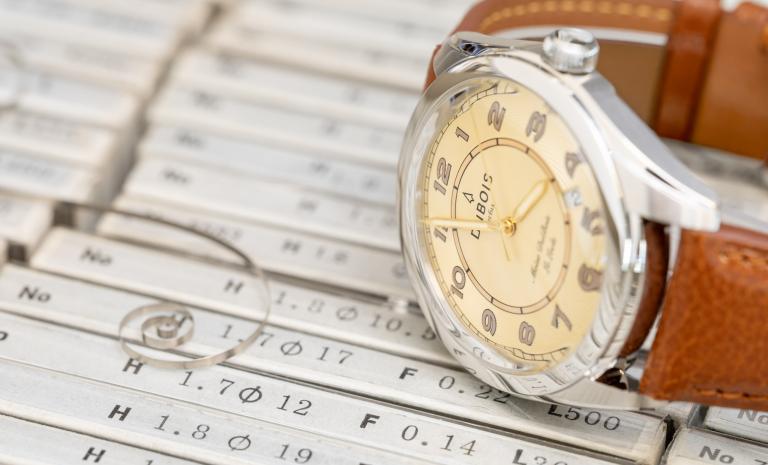
1751 - 2026: 275 years of Swiss watchmaking
DuBois et fils represents one of the longest-standing traditions in Swiss watchmaking, having produced watches continuously since 1751. In 2026, the company will celebrate 275 years of Swiss watchmaking.
The brand's roots in Le Locle
In the heart of Le Locle, one of the most important centres of traditional watchmaking, stands the historic DuBois family home, built in 1684. It was here that the members of the DuBois family demonstrated their entrepreneurial skills at an early age. As merchants, they traded in high-quality fabrics in Northern Europe, and did not shy away from long journeys or complex currency and customs systems. They networked skilfully and with foresight.
It was into this economically driven environment that Moïse DuBois was born in 1699 – into a family connected by trade, mobility and international relations. In 1743, Moise DuBois acquired his first Swiss pocket watch. He sold them with great success in countries such as Germany and the Netherlands. His enthusiasm for the technical sophistication and emotional power of these timepieces led to the birth of the brand in 1751. Moise DuBois opened his own watch workshop. Since then, watch production at DuBois et fils has continued uninterrupted.
In 1785, Philippe DuBois et Fils S.A. was officially founded in Le Locle. Over the following decades, numerous high-quality pocket watches were produced, some of which are now on display in the Patek Philippe Museum.

The historical context
Innovative figures such as Daniel Jeanrichard, who made his first watch in 1681, and Abraham-Louis Breguet, who established his workshop in 1775, had a profound and lasting impact on the watchmaking industry. Inspired by these pioneers, other watchmakers established their own brands, including DuBois et fils.
For a long time, however, the founding date of watch companies was not considered particularly significant.
Vacheron Constantin sparked an initial discussion in the 1940s when the brand was permitted to change its founding year from 1785 to 1755. It has been considered the oldest Swiss watch manufacturer still in existence ever since.
This prompted other brands to adjust their founding dates too. The then owners of Blancpain changed their founding year from 1815 to 1735 — a date which is somewhat controversial — and suddenly found themselves older than Vacheron Constantin.
Favre-Leuba also refers to an early founding year. However, there is no evidence of uninterrupted watch production since 1737.
Girard-Perregaux is also one of the earliest documented names in Swiss watchmaking. The brand's roots date back to 1791.
Swiss watchmaking has many other traditional names. DuBois et fils can be clearly classified: according to the inventory book entry, watch production has been documented without interruption since 1751 and remains firmly anchored in Switzerland to this day.

International Trade and Expansion
DuBois et fils experienced its heyday through the manufacture and global distribution of pocket watches. From 1844 onwards, the family business established branches in Switzerland, Amsterdam and Frankfurt, and conducted trade as far afield as the United States. The brand's lasting impact was shaped by creativity, economic courage and a vision that transcended borders.
In 1910, they added wristwatches to their range for the first time. Since 1950, they have been produced exclusively in limited editions. This exclusivity makes these timepieces particularly interesting for collectors.
Traditionally anchored, repositioned
Thomas Steinemann took over the company in 2010. He repositioned DuBois et fils within the luxury watch industry without losing sight of its historical roots. The art of traditional Swiss mechanical watch movements is consciously preserved, practised, and passed on.
The founding family is still involved in the company today, now in its tenth generation, and is actively involved as co-owners.
DuBois et fils represents 275 years of authentic Swiss watchmaking.