Stroll through Grenchen
Between the Aare landscape and the southern Jura chain lies Grenchen – the second largest municipality in the canton of Solothurn. At first glance, this town, with two train stations and its own airfield, doesn’t seem particularly spectacular.
Yet this town in the Swiss Mittelland is full of fascinating stories. The beginnings of Swiss watchmaking history are not only visible here, but can also be experienced.
Bygone times come to life
A short walk from the Grenchen North train station – slightly downhill, along school buildings and parks – leads to the Museum of Cultural History. This is an excellent place to immerse oneself in the history of the local watchmaking industry.
In the entrance area, visitors are greeted by a whiff of the 1950s, the "golden age" of the Swiss watch industry: a kitchen with aged household appliances, cocktail chairs, kidney-shaped tables and flash lights are reminiscent of the times in which our parents and grandparents lived. The past comes alive here. It is the prelude to a voyage of discovery through the last hundred years of the watch industry.

The Schild watch family in Grenchen
The history of the Schild family, whose manufactory produced our movements – the Caliber AS-1895 and the Caliber AS-1985 – is well documented.
The Schild-Hugi couple married in 1873 and started a family with ten children. Adolf Schild first worked in his brother Urs's watch company, where he served as technical director before founding the watch movement factory A. Schild & Cie. Pauline Hugi made a significant contribution to the success of this young factory with her own shop. Two portraits of the two spouses adorn the stairwell.

Upheaval, growth and crisis
The descendants of the Schild-Hugi couple converted the watch factory into a public limited company and changed its name to A. Schild SA, or ASSA for short. Among others, Adolf Schild-Behnisch (1879-1972), who joined his father's company in 1898, was responsible for this change. He first took over the technical management and from 1936 the commercial management.
The book "Rudolf Schild-Comtesse: Der Uhrenpatron und das Ende einer Ära" (2015) by Bettina Hahnloser provides a detailed account of the fascinating developments in the Swiss watch industry. Despite the First World War plunging the industry into a deep crisis, it states that ASSA grew to become the leading movement and finishing factory in the Swiss watch industry.
The change from the pocket watch to the wristwatch led to a trend-setting upheaval. Adolf Schild-Behnisch of ASSA was open to innovation and was involved in 1926 when the world's first mass-produced wristwatch was presented to an international audience at the Basel trade fair. After this peak, the watch industry faced new stumbling blocks. Market regulations put pressure on the industry. Changing structures and conditions strongly influenced the fortunes of the watch industry. The Second World War also presented many challenges. The watch industry underwent major changes.
Following cyclical fluctuations in the world economy, there was rapid growth in the post-war years. ASSA achieved a breakthrough. To this day, the 1950s are referred to as the «Golden Age» of the Swiss watch industry.

Connection with DuBois et fils
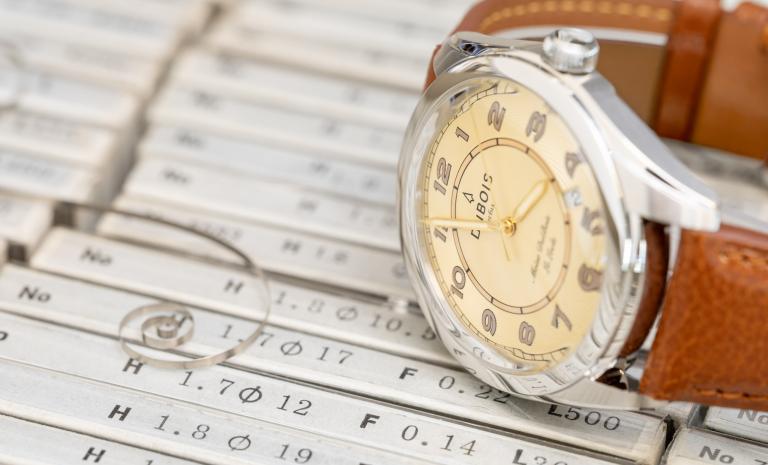
It was during these golden times that our Caliber AS-1895 was produced in Grenchen. DuBois et fils has since breathed new life into the movement: Every DBF007 Diver watch is powered by an authentic A. Schild SA movement. Each of these 330 automatic movements has a digital counterpart in the form of a so-called DBF-Token, which is based on blockchain technology.
DuBois et fils has reworked and revived an extensive stock of historical movements. These movements are robust, resistant and reliable. They have never been used and are a rarity.
The AS-1985 Calibres from the 1960s were also manufactured by A. Schild SA in Grenchen – they now power the DBF008.
The names A. Schild and FELSA represent an era in Swiss history when Grenchen became an important centre of the watchmaking industry. Here, it is well worth following in the footsteps of the past.
At DuBois et fils, historic movements from the 'golden age' are enjoying a renaissance; they are carefully fitted into new watches, thus finding their way into the present day.